Wednesday, 3 October 2012

The News - According to Travellin Bob


I’m a bit of a news junkie really.  I can happily spend hours reading the BBC website, mainly the Sport section but also the News, as well as the Guardian and Independent sites, and comparing notes……that way you get a more rounded view of what’s going on, and the various prejudices from the individual hacks writing the pieces tend to cancel each other out.  I watch BBC World News a lot too – in many places I’ve been to it’s been my only English language tv station – and CNN from time to time (although it tends to be a bit too US-slanted for my taste, and in Mark McKay has probably the most irritating sports presenter in television history).    I know, I’m a sad bastard really…..

The other thing I enjoy is the Comments sections that frequently follow news items or blogs, and I’m continuously amazed at what people say.  Yahoo News is the worst offender – their reports tend to be badly written and essentially distilled from other sources like Reuters, AP or other news sites and papers: very little is original content.  But the comments!  Nowhere have I seen such an outpouring of ill-educated, semi-literate and xenophobic nonsense gathered together in one place!  No matter what the story (I use the term in its loosest sense) the Comments are bound to be flooded with anti-government abuse, racist hate-speech and pathetic attempts at humour that fail to crack a smile.  It never ceases to amaze me.

But it’s interesting to see some of the stuff being written.

Over the past couple of days for instance:


Another day, another banking scandal.

When all this financial crisis kicked off four years ago with Lehmans collapsing (and it’s incredible that it was that long ago!), a number of other banks, mainly in the US started panicking – as did the US government and regulators.  With good reason – Lehmans nearly brought down the US economy and its aftershocks were felt world-wide (and indeed continue to be so).  Had another bank gone belly up that would have been that, given the size and inextricably linked nature of the global economy nowadays.  All this led to a collapse in confidence in the banking industry, whose participants – and indirectly that includes me – are being portrayed with breathtaking inaccuracy and bile, as Evil Incarnate.  The knock-on effect has been a collapse in confidence in many economies, especially in Europe, where banks have had to be bailed out all over the place – Allied Irish in the Republic of Ireland, RBS and Lloyds in the UK, Dekia in Spain to name just a few.  That in turn has led to Ireland calling for an EU bail-out to avoid a national bankruptcy, Greece struggling for three years to avoid doing likewise, and Spain, Portugal, and Italy all waging their own battles.  Even Germany and France, the powerhouse economies in the EU, are struggling.  It’s a sorry state of affairs, not helped by politicians, of every flavour, whose main commonality is a breathtaking lack of knowledge and experience in a banking industry that they seem hell-bent on destroying, being unable to reach any kind of a consensus on what needs to be done to sort out the mess.

I’ve posted a few columns on here previously, defending bankers, and I make no apology for that now.  I completely agree that there are a great many people employed by banks who are motivated solely by greed, and whose actions have been indefensible, frequently encouraged by a prevailing culture, particularly in investment banking, that profitability is everything and will be hugely rewarded.  But the vast majority of bankers – whether at an executive level or behind the counter of your local branch – are pleasant and honest people, dedicated to providing a good and risk-free service to their customers, and to earn a reasonable wage to keep their families in food, clothes and housing.  So there has been a lot of completely unjust criticism leveled over the past years, and it shows no sign of abating.

Which brings me finally round to the story behind this subtitle.

One of the US banks that needed help when the shit hit the fan was an outfit called Bear Stearns.  They were an old firm, leading players in the major government bond markets in the US and elsewhere, and especially in the mortgage bond markets that were at the root of the Lehmans demise.  They were also criminally negligent, greedy, and liars.  I worked in their London office for a few years, back in the 90s, and I can safely say it was the most unpleasant three years of my working life, so the news that broke this week does not surprise me in the least.  There were people there at that time who would happily screw their own families to make a buck, and it was a culture that came from the Chairman down.  When the regulators and US government realized that the company  was about to do a Lehman, they also realized that following the similar near-demise of Merrill Lynch (another massive bank – and coincidentally former employer of mine) that was averted only by a government sponsored take-over by Bank of America, Bear too had to be saved at all costs to avoid the entire US banking industry (and hence economy) collapsing.  So they persuaded JP Morgan Chase to take over Bear Stearns – which they did, over a weekend.  It was clearly a rushed job, and in hindsight perhaps not done particularly well.

Because it turned out that when JPMC bought Bear, they saddled themselves with billions of dollars’-worth of mortgage backed securities that were, essentially, worthless.  Toxic is probably too kind a word to describe it.  It also became clear that there was a lot more of it around that Bear had managed to sell to its customers and other financial institutions, by misrepresenting the value and quality of the securities in question, and the supporting mortgage assets.  Let’s be honest here – by lying about the things.

And now, years later, it’s all come home to roost as the New York DA has filed a suit against JPMC for in excess of USD20billion in damages.  Now I feel very sorry for JPMC here – the crimes, when proven (as I’m sure they will be, should it actually get to court) were committed by people working for a company that essentially no longer exists as an independent entity, and who quite possibly are no longer employed by JPMC or anyone else in the industry.  And yet the blame, and of course vitriol in the blogs and comment sections, is being heaped squarely upon JPMC’s  corporate shoulders.  In an ideal world, JPMC would not have touched Bear with a barge pole – it’s hard to think of two banking organizations more polar opposite than those two – and would therefore not have become embroiled in this business at all.  The government and authorities who now seem intent on prosecuting them brokered the entire merger, and it seems to me hypocritical in the extreme to pursue this case. 

But pursue it they will, until an out of court settlement is somehow brokered – but whatever happens, JPMC will always be guilty in the Court of Public Opinion.


A Business Bank – just don’t let the Civil Servants run it!

And now today, the Right Honourable Vince Cable, the Business Secretary in the UK Coalition government, announced at his Liberal Democrat Party Conference that the government is to invest a billion pounds into a “business bank” to provide capital for new businesses, and hopes that a similar amount will come from private investment.   He says this is being done because businesses are finding it increasingly difficult to obtain capital from high street banks – which, given the amount of criticism that he and other politicians have been heaping upon them for the last few years is hardly surprising – so they need an additional source of funding.   Now in the old days, this additional source would have been – the investment banks.  Or the stock markets.  Or venture capitalists.  In fact, the very lenders who are now being pilloried and threatened with being regulated out of existence  

You see my point, I hope.  This constant ill-informed criticism of the financial services industry has made all of these traditional “additional sources” highly unpopular and seemingly untrustworthy lenders, even though they generally are not.   It seems that start-ups are now less than willing to go to such sources for their capital requirements, and conversely high street banks are less than willing to risk making an investment in a start-up company. 

It seems to me that we have now reached the point where Cable (and he has been consistently one of the most vociferous complainants in the anti-banker lobby) and other politicians should actually shut up.  Their criticism has made the lending business grind to a halt (the very thing they have been demanding for months should not be allowed to happen), and starting a business bank is an expensive and unnecessary course of action.   The government would be far better employed in helping re-build public confidence in the existing banking industry, and ceasing this constant carping would be a good start.   But I’m not going to hold my breath waiting for that to happen – politicians, generally speaking, seem more concerned with saying the right thing to please their constituents and retain their seat in Parliament than being seen to do the right thing.  The Court of Public Opinion would much rather see and hear criticism, no matter how ridiculous, of banking (or whatever happens to be the current pantomime villain) than see and hear praise or conciliatory actions.  As would news editors – it makes for far better copy.

The other issue with this business bank idea, it seems to me, is that as a government-sponsored bank it would presumably be run by civil servants – or at least civil servants would hold senior positions in it.  If that were not the case, then it would be just another bank, after all – and hence should be subject to all the problems that go with that status.  From a political point of view, God forbid that should be the case!  Frankly, after the third news story, that is the last thing I would want.

Over the past year or so, there have been a number of rail franchises up for renewal in the UK.  The most lucrative is the West Coast Mainline, run for the past several years (with increasing success and profitability) by Virgin Trains.  Recently, the bid process ended and the Department of Transport, in its infinite wisdom, handed the franchise to FirstGroup, a combined road and rail operator, effective December this year.  Virgin immediately lodged a protest and insisted that the numbers in FirstGroup’s bid didn’t add up – there was no way, said Virgin, that FG could spend as much cash on new trains and infrastructure and give as many cheap tickets without losing money hand over fist and compromising passenger satisfaction (and as a worst case go bust and require government rescue).    Sour grapes, yelled the Court of Public Opinion, you’re only saying that because you lost.  Rubbish, said the Minister of Transport (since replaced in a Cabinet re-shuffle), the bidding process was completely fair and above board and we awarded the contract to the company best able to provide value for money and quality service.  Undeterred, Virgin obtained an injunction preventing the handover until the bidding process had been reviewed again. 

Today their action was totally justified, as the new Transport Secretary scrapped the entire bidding process and contract, returning operations of the line to Virgin.  He cited serious errors made by the DoT in coming to their decision in favour of FG, suspended four civil servants directly involved in the process, stated clearly that there was no blame attached to any of the bidders (including Virgin and FG – there were two other losers) and that the cock up was entirely the Department’s fault.  He also stated that a total of GBP40million would be refunded to the bidders to cover the costs of their bid submissions. 

Let’s leave aside the question of how each bidder could spend an average of ten million quid preparing a document stating how they would run a railway line and make money as well as providing a good service (I can only assume that the likes of Deloitte’s and Accenture or other consulting firms were involved, and the bulk of these costs cover their fees).  Let’s also leave out the astonishing appearance of an apparently honest politician (not a hint of cover-up or trying to blame someone else here).   The issue I have is that it seems CIVIL SERVANTS got their sums wrong, and made completely the wrong decisions – and these are the sort of people Mr. Cable is presumably considering should be responsible for running a business bank, lending money.

You couldn’t make it up, could you?

I’ll sue you!  No, I’ll sue you!!

Finally, we have the continuing Phone Wars:  Apple versus Samsung (and anyone else who dares produce a roughly rectangular smart-phone that includes a touchscreen user interface).  This story is truly ridiculous, and again has been running a few years now.

Apple started it with their iPhone.  A game changer if ever there was one, and an idea that has taken the world by storm and changed the way we look at mobile phones for ever.  It was innovative and looked lovely, even if the first model was a bit clunky and unreliable.  The second was better, but initially had signal problems because of the way the aerial was positioned – Apple fixed it quickly, and successive releases have built on that design, adding new bits and pieces, and tweaking things here and there.  Being Apple, they of course charge a ludicrous price for it, and also being Apple (and hence uber-cool) everyone buys the things by the ton.  Incidentally, can someone explain to me how the new iPhone 5 can have an entry level model in the US priced at USD199, whereas in Malta recently I saw an old 4S (the preceding and now outdated and replaced model) was on offer at one store at a “reduced price” of EUR 499 – by my reckonings three times the American price – and you’re not even getting an up-to-date spec!

But since the phone’s introduction, other companies have come up with their own smartphones, and a lot of them are much better than the iPhone.  HTC, Nokia and (especially) Samsung with its Galaxy range have all come up with devices that look better, work better and often have much better functionality than the iPhone, which now looks boring and dated.  The screen is smaller, it looks less attractive and chunky, the picture quality seems less good than the others….the list of differences is long and getting longer by the release.  Apple’s response, rather than working hard to innovate and come up with something new and fresh to blow the opposition away as they did previously, has been to throw millions of bucks at the legal professions and launch lawsuit after lawsuit, alleging theft of intellectual property rights, patent infringements and God knows what else.  Samsung (Apple’s main target) has predictably responded by counter-suing on the same grounds. 

The results are interesting.  Whenever the case is heard in America, and in particular Apple’s own California back yard, they win the case – most recently a billion dollars was awarded against Samsung and a range of Samsung devices (mostly outdated and replaced anyway) banned from sale in the US.  Yet when the case is elsewhere (and they are going on all over the world – Europe, the Far East, Australia to name but three locations) then Apple tend to lose.  No-one seems to be winning outright, and sales seem unaffected.  The new I5 is the fastest selling new phone ever, but Samsung is still selling more phones globally than anyone else – unsurprisingly, because its flagship Galaxy S3 is a bloody fantastic piece of klt.

It all seems ridiculous to me.  How can you accuse someone of copying the shape of your phone and complaining its rounded rectangle breaches copyright?  Sorry, but for the most comfortable and efficient use a rectangle is the best shape to have and there are only so many ways of changing it.   To me, it’s like Adidas suing Umbro because the latter’s new football is round – well, yes, balls generally are.  Other complaints are concerned with way data is transmitted wirelessly – Apple say everyone else is copying them.  Analogy: Adidas complaining that Umbro’s valves (for pumping the ball up) is the same shape as theirs.  Touchscreen interface?  OK, tell me how else you can use of them without using your finger to swipe across the screen and activate something.

Crazy, absolutely crazy.   The only people happy about the situation are the lawyers, who are creaming off huge fees from all the participants – costs that are no doubt being passed along to the consumers, you and I.   And to what end?  Apple fanboys will still stupidly queue round the block for a week to get their grubby little mitts on the latest release, no matter how crappy it is…..because it’s an Apple, dude!  The rest of us  (dare I say the more sensible punters?) will probably look at a number of alternatives and buy the one we think best – be it a Galaxy S3, the HTC One (almost as good), or the Nokia Lumia 900 with its Windows 8 operating system.  Or something else entirely – Blackberry perhaps, or the  new Motorola Razr that looks pretty sexy. 

I’ll be interested to see what happens next after last week’s classic Apple fuck up (undoubtedly their worst ever).  The new iPhone 5 dropped Google Maps entirely from its range of pre-installed apps, and replaced it with its own version, Apple Maps.  The trouble is it doesn’t work.  Users have bombarded the company with complaints because the maps are totally inaccurate and hence useless.  There have been reported errors like the London Eye being relocated to the Welsh coast, and Stonehenge to the centre of Edinburgh.   This all forced Paul Cook, the Blessed Jobs’ replacement as CEO, to issue a statement of apology in which he blamed software glitches (no, really?) and recommended that people use “alternatives like Google and Nokia Maps instead”.  Say what you like about him, but Jobs would never in a million years have allowed something that serious and stupid to have happened. 

Wednesday, 26 September 2012

The Rage of Islam


Islam is a truly global religion.  It already has a quarter of the world’s population as followers, and is the fastest growing religion in the world.    Wherever I go in the world, I see mosques alongside Christian churches and cathedrals, and even (notably in Almaty) alongside Jewish tabernacles.  I confess to knowing little about the faith, nor ever having read anything from the Koran, but from conversations I’ve had with Muslims on my travels (and a brief read through of Wikipedia’s page on the subject) the central core beliefs of One True God, peaceful co-existence, and helping others less fortunate than yourself, in order to obtain entry into Heaven, Nirvana or (simply) the afterlife do not seem to differ that much from Christianity in all its guises, or Buddhism or pretty much any other faith (I exclude Scientology here).  I understand that in other areas, Muslims are stronger in their insistence that “their” God is the one True God, that Mohammed is the Real Prophet (and that Jesus was merely a prophet rather than the Son of God), and that Sharia Law is the only true law.  There is more fasting in Islam (the Holy Month of Ramadan), women hold a lesser place in society than in Christianity or other faiths, and overall its followers take it much more seriously than any other faith I’ve been exposed too.  I’ve worked in banks in the Middle East where a room on each floor was set aside as a prayer room, and was used each day by people praying to Allah at the designated times – you never get a prayer room at your local NatWest.

I applaud that – there is nothing wrong with taking your religion seriously, even if I don’t do so, and with the followers of Islam that importance seems so much more genuine and of vital importance than the mealy mouthed version of worship that seems common elsewhere.  Whenever I see a US President, whether Bush or Obama, closing a brief tv address with “God Bless you all and God Bless America”, I’m afraid I cringe…..it never seems sincere to me, nothing more than a soundbite to appease the masses.   By contrast, when the Queen makes a similar “Gawd Bless You All” statement at the end of her annual Christmas message, it seems somehow to be sincere and from the heart, in a way that no President in my memory (that unfortunately stretches all the way back to LBJ) seems able to replicate.  I mean no offence to my American friends and readers – it’s just my perception.

There are, of course, many people across the US who take their religion very seriously indeed, particularly in the South – the Bible Belt – and even to extremes.  I watched a program recently on BBC Entertainment where Louis Theroux re-visited “The Most Hated Family in America”.  Now these guys were the classic example of American religious fanatics.  They run their own church, that has only a handful of believers, its tenets based solely on the grandfather’s personal interpretation on the Bible.  Like all fanatics, they are absolutely resolute in their version being the Truth and every other version a lie: we’re right and the rest of the world is wrong.  We’re on a fast train to Heaven and you’all on a one-way ticket to Hell and Damnation……unless you join Our Church, of course – that’ll be fifty thousand dollars.  Hallelujah!  Anyway, these guys actively travel across the US and stage pickets and demonstrations outside various churches – one that had a female minister, another where the pastor was openly gay – and these pickets invariably featured verbal abuse of the most virulent kind directed at anyone and everyone walking by, whether they were attending the targeted church or not.   The guy running the church even kicked his own daughter out of the family home because she danced with a guy who was not a church member at the end of term school dance – she was 17 at the time.  He was unrepentant, and said she deserved to go to hell…..hallelujah.  It was uncomfortable viewing. 

But one thing about Islam troubles and confuses me.  It is that to be a true follower seems to mean a sense of humour bypass.

                                                                       *          *          *

Over the years, there have been many situation comedies on tv or in the cinema that gently (more or less) mock Christianity – All Gas and Gaiters, for instance, or the Vicar of Dibley.  Father Ted, with all its politically incorrect parody of Catholic priests is perhaps the most extreme mockery – but some of the characters in it do bear an uncanny likeness to some priests and their housekeepers of my acquaintance.  In the cinema, The Life of Brian is without doubt the classic example and for its pains was banned in many towns and cities across the UK at its release, before more tolerant times allowed for its acceptance.  I remember seeing a studio discussion on the tv at the time, where John Cleese and Michael Palin, two Python stalwarts, defended the film in a live debate with philosopher Malcolm Muggeridge and some Archbishop (I can’t remember which) and succeeded in making them look complete idiots, old fashioned, bigoted and out of touch with late 20th century reality.  It remains one of my all-time favourite movies, and “He’s not the Messiah, he’s a very naughty boy” the best line in the history of cinema (but perhaps I’m easily pleased….). 

Judaism too has had its comedy moments on tv, especially in Britain I think – Never Mind the Quality Feel the Width in my youth, about an old Jewish tailor was awful and portrayed a stereotypical Jewish tailor.  More recently, Guy Ritchie’s movie Snatch, another personal favourite, featured a good line up of Jewish villains.  But in both, the mockery was more of national characteristics rather than the Jewish faith.  Even Sikhs and Hindus have had their moments of caricature – the Tea Wallah in It Ain’t Half Hot Mum is probably the best example: an embarrassing impression of a Sikh man-servant played by an English guy in full make-up including turban and waxed moustache, and an excruciating Indian accent (it makes me chuckle still, I’m afraid….).

But the point is, that in each of these cases, everybody recognized the characters for being parody, there to be laughed at as part of the performance and not meant to denigrate in any way the people or faith portrayed.  Even those Catholics or Jews or whatever that were offended, once they had made their feelings known by letters to the newspapers, interviews on tv or whatever, let things go, accepted the joke and moved on, peaceably, with their lives – and in private I’m sure quietly laughed along with the rest of us.  That surely is how it should be.

                                                                        *          *          *

Compare and contrast that with any non-serious (or even serious) view of Islam, portrayed in literature, film or whatever, and the furious reaction of Muslims worldwide.

Case 1: The Satanic Verses, a book released getting on for thirty years ago by Anglo-Indian writer Salman Rushdie.  I read the book and found it turgid and dreadfully dull.  I can’t remember the plot, and certainly not the few paragraphs that apparently were offensive towards Mohammed and caused such outrage throughout the Muslim world.  In any case, the Ayatollah Khomeini, then ruler of Iran after the overthrow of the Shah, was so incensed he announced a Fatwa against Rushdie – essentially an instruction to any good Muslim to guarantee his entry to Heaven by killing Rushdie.  The author spent years in hiding, using an assumed identity and under 24-hour armed guard for his own protection at a cost of millions of pounds. 

Case 2: The rise of al Qaeda and Militant Islam.  This has been an on-going problem for twenty or more years, and has led to the most appalling bloodshed and slaughter from the 9/11 tragedy to the current killing fields in Syria via the London and Bali bombings, the insurgency in Iraq after Saddam’s downfall and the Taliban activities blighting Afghanistan and Pakistan for years.  What the root causes for that little lot are I have no clear idea – I don’t think any one event triggered it all – but despite years of bloodshed and tit-for-tat killings there is no sign of it ending any time soon, despite the killing of bin Laden last year by US Navy SEALS in Pakistan.  Whole books have been written attempting to explain it all, and it is without doubt the biggest issue facing world peace today – and one that neither the UN nor any government seems able to come to grips with, never mind resolve.

Case 3: Most recently, The Innocence of Islam.  This is a quite appalling home movie apparently filmed in the US and placed on You Tube that has offended Muslims worldwide.  I’ve looked at It (or at least a ten minute trailer – it was all I could stomach), and it is the most awful pile of trash I’ve ever seen – I have home movies of my kids on my phone that are better quality.  The acting is dreadful, the script a joke, and I cannot understand how anyone in their right mind can take it seriously.  It is grossly offensive, and there are scenes and dialogue that do indeed poke fun at Islam and Mohammed in the most crude and unamusing way possible.  But here is the thing – the offensive bits have clearly been added in post-production, the dialogue dubbed by somebody else – the actor’s voice is totally different.  Really, it’s laughable – but tragically, instead of treating it (and its mysterious Egyptian -American maker) with the contempt it deserves, there has been an explosion of anti-American outrage across the entire Muslim world.  The American Embassy in Tripoli was stormed and the American Ambassador to Libya killed along with three members of his staff (the fact he played a key role in helping the insurgents topple Gaddafi less than a year ago counting for nothing).  There were other protests across North Africa, the Middle East, and as far as Malaysia.  After initial rioting, the Pakistani government declared last Friday a National Holiday to allow people to demonstrate “peacefully in demonstration of their love of Islam”.  More than 30 people died in the subsequent rioting.  Obama and Clinton apologized to the Muslim world, and condemned the film and its maker, but quite rightly condemned too the violence that has followed.  As they rightly pointed out, the film is the work of a single misguided individual and not in any way condoned or supported by the US government – and in any case under the Freedom of Speech laws in the US there is actually nothing illegal about what he has done, no matter how distasteful it might be.  They have clearly wasted their breath, as the protests continue unabated.

I can understand where they’re coming from – freedom of speech is perhaps the most important benefit of a free and democratic society.  Certainly that was a point Rushdie made during his hidden years – he has remained steadfast in his belief that as a writer, it was his duty to write stories about any subject that occurred to him, even if the tale offended people.  It’s a belief I share, else I would not be writing these words now.  The Python crew used a similar view in defending Life of Brian and pointed out that anyway the film was about Brian Cohen not Jesus Christ…..  Many other comedians and writers have equally defended their art by insisting that no individual or institution – whether the Queen or the Catholic Church, Prime Minister or Pope – should be exempt.  It is a consensus not shared by the church of Islam.  To mock Islam is an offence, against Allah and his followers.  But mocking God and the Pope could be considered a sin too, against God and his followers.  The difference is that with Christianity such things are forgiven.

                                                                         *          *          *

The problem I, and most people, have is equating a religion that is supposedly a peaceful one, with the most extreme violent reactions that invariably follow any critical (intentional or otherwise) comment or view on Islam.  For a supposedly forgiving faith to preach Fatwa and jihad against non-believers makes no sense at all to this mystified Englishman.  If the idea is for world domination and the scouring of all non-Islamic faiths, then frankly the methods being employed by Islamic fundamentalists make Hitler’s antics seems like a walk in the park – and should make us all fear for the future.

I wrote on here a few months ago a piece about Anders Behring Breivik, who justified his slaughter of 77 young Norwegians last year as being a reaction to what he perceived as an Islamic invasion of Europe and his homeland that needed to be stopped.  I wrote then that, while his actions could in no way be condoned (and he is as guilty as hell and should spend the rest of his miserable life rotting alone in a cell somewhere) he actually had a point to make there.  I cited a number of e-mails and other communications I had received over the previous couple of years that made his claim about the existence of an extreme right wing anti-Islamic group not as far-fetched as it was made to sound in the court case. 

The events of the past couple of weeks make me worry for the future.  Clearly there is a very militant and violent strain of Islam, acknowledged everywhere I think, that has an open anti-Western agenda.  The militant cleric Abu Hamza and four others, held for several years in British prisons on terrorist charges, have this week lost an appeal at the European Court of Human Rights and will soon be extradited to the US to face more charges and potentially life in a maximum security jail – an event that is bound to cause yet more outrage and violence across the world. 

The belief is that Militant Islam is only a very small minority of Muslims.  That may well be true – but what seems unarguable is that the militant minority is extremely well organized, extremely well-armed, and quite willing to die for its perceived cause.   It therefore is extremely dangerous to the rest of us.  Is it not possible that the peaceful majority of Muslims who do not follow this course, could actually do something about it themselves, from within?   Is it perhaps time for Muslims everywhere to reclaim their faith somehow, take it back to a more peaceful path, before it destroys us all? 

I hope that is case – but I fear it’s gone way too far for that to happen now.  I believe that Islamic militancy is something we are all going to have to live with, and take whatever precautions we need to in order to stay safe.  Please don’t think for one minute I am racist or anti-Islamic – I’m not.  It’s not possible really to be racist in my job, and through that job I have many good friends in other countries and societies, including Muslims.  I strongly believe an individual’s religious beliefs are solely the business of that individual, and nothing to do with me at all – but I do not expect that individual to try and force those beliefs on to me (in the same way that I would never consider trying to force my beliefs on someone else).   I certainly would never expect (or respect) anyone who reacted with anger or violence if I disagreed with their opinion. 

I try to be tolerant.  I condemn all violence, but especially that carried out in the name of religion or politics – whether Catholic against Protestant, Jew against Palestinian or Muslim against the World.  I sincerely hope that someone, somehow, can find a solution to these problems, because I worry about what sort of a world my kids are growing up into, or my grandkids are going to be born into.  I have no faith in the UN to do so, and no faith in the current crop of politicians to do so either – by and large, they’re a poor bunch.

It’s a rum old world, as my mum used to say.  And frankly, mum, not getting any better.

Thursday, 13 September 2012

The George Cross Island


I sat in the back of the cab and gazed out at the sandstone and whitewashed buildings, wondering when I would recognize one from my previous visit.  We swept round a bend and down a narrow access road, then picked up a dual carriageway and through a tunnel that I had never seen before.  As we came out the other side, we slowed and joined a queue of traffic at a roundabout, and edged round to take our exit.

And there, finally, was a memory.  The building was typical of this area, built apparently from sandstone blocks but painted in pastel colours – in this case a washed out pale yellow.  It had two storeys below a red tiled roof, and the door and windows were both covered with intricate wrought iron grilles painted black.  On the wall facing the road, also in black, was a wrought iron Gothic script sign that read “The Cottage”.   It was a restaurant we had used a couple of times, that I recall served an excellent dish of local rabbit stew, and another of local sausages.

As we passed, I swung round in my seat and looked up the road leading away from the opposite side of the roundabout, trying to spot another familiar building, a hotel,  that I knew was there but I couldn’t see it.   But at least I was comforted, and had seen something familiar after two weeks vainly trying to do so.  I knew already the country had changed – inevitably, after 10 years – but I had been surprised at just how many differences there were.

The one way system here had been confusing back then, but is infinitely more so now.  There are bridges and tunnels that I have no recollection of at all adding to the confusion.  I remember getting in the wrong lane at a roundabout and missing my exit, forcing me to go round the entire system before I could have another go – it took 5 attempts to eventually catch my exit, and even then I had to carve across three lines of cars and buses to do so, narrowly avoiding collisions and setting off a cacophony of angry car horns.  Now, I’m not even sure I would recognize the roundabout, never mind the correct exit.

It’s another example, like Ireland’s Road to Nowhere and farmer’s trick of herding cows back and forth across the border with Northern Ireland to gain import/export subsidies, of just how much can be achieved by becoming a member state in the European Union.

                                                             *          *          *

I’m writing about Malta, where I’ve been working for a couple of weeks now.

Ania and I came here for two weeks’ vacation, in October 2002.  I remember it well, because while we were here, a terrorist attack in Bali left over 200 people, many  of them Australian tourists, dead and another 240 people injured as a series of bomb blasts devastated a couple of popular nightclubs and the US Consular office.

But we had a lovely holiday, I remember.  The hotel was a private one owned by a relative of a work colleague so we got special rates and used BA Airmiles for the flights, via Gatwick.  So we flew Warsaw – Heathrow, hired a cheap car to drive down to Gatwick (visiting some of Ania’s friends in London en route), then flew to Malta early the next morning.  It was also the last holiday for just the two of us, with no kids or in-laws joining us.  I don’t mean that how it sounds: we ALWAYS have terrific holidays, and taking the kids to new places and showing them new things is one of the great joys in my life……but sometimes the romantic in me feels it would be nice to be just the two of us – and I’m sure every couple with kids has the same passing thought sometimes.   It’s human nature.

While we were here, we decided to try scuba diving.  The waters around the islands are among the clearest in the world, so perfect for snorkeling or diving.  There are also a lot of interesting dive sites scattered around – a wealth of sunken warships and airplanes from the furious battles that took place during World War 2 when the island, a long-standing British sea base, was under siege for three years or so (for which Malta was, uniquely, awarded the George Cross, Britain’s highest non-military decoration for bravery), as well as many natural lagoons and underwater caves. Scuba is big business in Malta and there are dive schools everywhere.   We chose one at random and enrolled in the course, three days if I remember correctly, part classroom but mostly practical – in the water - , that led to a PADI Open Water Licence.  There were a couple of other people enrolled, crew from a cruise ship that was visiting the island for a few days.  The guy was so keen he had bought himself a dry-suit, mask and flippers, while the rest of us used the school’s gear.   We had an initial half day or so of classroom stuff, learning all about pressures and how not to contract the Bends by surfacing too quickly, how the dive belts work to maintain your equilibrium under water,  how to breathe properly from the tanks and so forth.  It was all interesting stuff…..but I’ve forgotten most of it.  Then the trainer kitted us all out with wetsuits, flippers, masks, regulators (the breathing hoses) and the weight belts, we piled into the back of an old rusty Transit mini bus and set off for our first dive.

It was at a small harbour along the coast from Sliema, towards Gozo, that enabled us novices to climb down a ladder into the sea, at the bottom of which was a ledge that we were able to stand on, completely submerged (unless you’re more than about 6 foot 6 tall).   From the ledge, you can then step off and sink the remaining six feet or so to the sea bed.  All very simple and straightforward.  The idea on that first dive was to get acclimatized to the equipment, practice breathing, maintaining our buoyancy, and master a couple of important safety manouevres – namely, taking off the mask and putting it back on again, and doing likewise with the air tanks, both under water.    Now I should add at this point that by the time I was 11 years old, I had come very close to drowning on three separate occasions, and been left with a fear of deep water (i.e. deeper than I am tall) that persists to this day.   I hoped that taking this course would help finally conquer that fear – I had complete faith in both the trainer and the equipment, and knew that unless we were unexpectedly attacked by a great white shark or something I was not going to die.  The sea was a flat calm and the water absolutely crystal clear – it was like looking into a swimming pool twelve feet deep with a rocky bottom, and filled with hundreds of fish darting in and out of the rocks and seaweed fronds.  Beautiful.

Only I couldn’t hack it.  I went into the water last, slowly picking my way down the ladder, clutching each rung tightly.  I could feel panic rising as I got deeper into the sea, and by the time I stepped off the ladder onto the shelf, with the top of my head about 6 inches (six inches!!!!  God, this is embarrassing!) under the sea, still clutching the ladder, I was close to panic.  I looked up, briefly, at the surface of the water, gently lapping at the end of my nose, the sun shining brightly overheard – I could even dimly hear the cars driving by.  Then I looked down, beyond the shelf.  I could see the bloke from the cruise ship lying comfortably on his back, maybe a foot above the sea bed, perfectly balanced and arms folded, watching the fish.  I could see his girlfriend swimming clumsily towards him.  I could see Ania watching me, a smile on her face (I could tell from her eyes), loving every minute of it, and the instructor, floating a couple of feet away, clearly aware of my fear, hand held out to help.  And I froze.  I felt sick.  I felt dizzy.  I felt terrified and ashamed, all at once.  I took a deep breath, and stepped off the ledge…..I sank under the influence of the weight belt, panicked, and hit my emergency regulator, flooded the vest with air and shot back to the surface, where I clutched the ladder grimly and tried not to scream.

Believe me, there is no exaggeration there at all.  I have never, ever been so afraid of anything in my entire life, dentists included, either before or since.  Pathetic but true.  I clung to that ladder like life itself while my mask misted up and I breathed canned air instead of the real fresh stuff.  After a moment, Ania and the trainer bobbed up next to me, to see if I was ok.  I couldn’t speak, I just nodded, shook my head, nodded again….I had no bloody idea whether I was ok or not.  Eventually I spat the mouthpiece out, and pantingly told them I was ok, give me a minute and I’ll try again.  Don’t wait for me, you go ahead, I’ll catch you up……  It was all bollocks, of course – I felt terrible, but didn’t want to spoil their fun.

They went back down and continued the lesson.  I spent the next half hour desperately trying to summon the courage to try again.  I put the mask back on, after clearing it, put the mouthpiece back in and once I’d eventually regulated my breathing to something other than terrified panting, went back down the ladder.  I stopped just above the ledge, the top of my head just at surface level, and tried to make myself let go.  But my hands refused absolutely to release their manic grip on the ladder.  I went back up, took another five minutes breathing air, then tried again.  I did that perhaps four or five times before accepting I was never in a million years going to manage this and hauled myself back out onto the harbour.   There I sat miserably, watching everybody having a great time on the seabed.

I quit the course.  Ania carried on, and over the next couple of days mastered all that was needed in another series of dives, each one in water deeper than before, ending with a dive from a boat anchored in the Blue Lagoon at Gozo, one of the best dive sites in the world.  The crystal clear water is deeper here, and an incredible rich blue (giving the place its name), and at the bottom there is a system of caves to swim through.   I sat on the boat, burning in the late summer sun, frankly feeling a bit sorry for myself, while everyone spent the best part of an hour and a half exploring the sea bed and the caves.  Eventually, they came back, and I and the boat’s crew helped them back on board.   I had never seen Ania look so happy before (and rarely since) – she absolutely loved it.  The next day at the school, she and the others sat a written examination.  I was allowed to sit in and act as a translator if needed (since the paper was set in English).  Of course, she passed with flying colours and is now the proud owner of a PADI Open Water Diving Licence, the best qualification of its type.

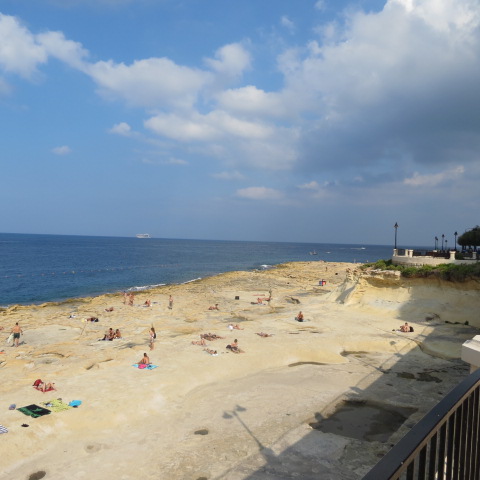
We hired a car, as usual, and explored the island a little.  It’s very small, only about 40km end to end, and about half that at its widest point, and criss-crossed with a maze of little narrow roads, flanked by low dry stone walls.  There were no motorways, and very few stretches of road that had more than a single carriageway in each direction – notably the airport approach roads, the one way system through Valletta and Sliema (and even then not all of that), and the approach to the port at the island’s northern extremity, called Cirkewwa, from which the Gozo ferries and dive boats sail.  Apart from in the cities and the main east coast road traffic was negligible so we had a good couple of days exploring, getting lost and trying to find a decent sandy beach.  We never did manage that – they are few and far between, a handful of tiny and mostly inaccessible coves.  The islands (Malta, Gozo and the tiny, car-less Comino) are rocky outcrops in the central Mediterranean 80km or so south of Sicily and about 300km north of Libya.  There are plenty of bathing and sunning areas around the island, but invariably they are expanses of rock, mostly sandstone, flattened and smoothed by the waves, and slippery – getting in and out of the water could be interesting.

                                                       This passes for a beach in Malta....

Historically, the islands have been ruled by a succession of powers, going back to Phoenician times, due to their strategic positions, but since 1974 have been an independent state.   St.Paul was shipwrecked here, and the country is constitutionally Catholic.  There are many ancient archaeological sites scattered around, nine of them UNESCO World Heritage sites, including some Megalithic Temples that are among the oldest buildings in the world.  All these different rulers have left their influence on the island’s architecture – there is a rich mixture of building styles from Middle Ages Moorish to modern tower blocks and everything in between.  The place looks very barren, as befits its low rainfall, and relies heavily on tourism and shipping (it’s a major port) in its economy since agriculture is so difficult in this parched earth.   International banking is increasingly important too – which is why I’m back here.

                                                              *          *          *

The island has indeed changed a lot and this is evident on final approach to the much expanded airport. 

When I first came here, there was a very clear rural area between the airport boundary and the edge of the cities – Sliema and St Julians and Valletta and the other urban communities clustered around the bay on the east coast of Malta were all clearly and visibly separate communities.  Now, they all seem to run into each other to form a single urban sprawl that reaches virtually to the airport entrance.   There are new roads and bridges and tunnel systems to help the increased traffic volume get around – and after nearly three weeks I’m no nearer to being able to figure out where I am on our daily commute from hotel to bank and back than I was on the day I arrived.   The driver seems to take a different route every day, and always makes his way through a bewildering succession of narrow and winding back streets to avoid the main traffic arteries.  I’ve given up trying to figure out where I am at any given point. 

                                                              The new urban sprawl

I’ve been staying in some super spa hotels in and around Sliema.  They are being booked and paid for directly by the bank and hence are way above the normal quality my company would use, so it’s made a very pleasant change.  All of them have been minimum four star, and worthy of the rating (unlike some I’ve used before in London and elsewhere), with very comfortable rooms, plenty of food and drink choices (at least four restaurants and bars available at each), super waterfront locations and great facilities like infinity pools on the roof and fitness centres.  Last week’s choice really took the biscuit however – we were placed in a 5 star spa hotel (it has an adjoining 4 star section) that gave me the most ridiculous room.  I had a Jacuzzi in the bathroom, a walk-in shower that doubled as a sauna, a thing like a coffin that is apparently used for all kinds of hydrotherapy treatments (not that I could figure out how to use it…), and another two-person spa bath in an elevated platform immediately behind the glass headboard of the most enormous (and comfortable) bed I’ve ever slept in.  A sliding door led onto a big balcony with seats and a table overlooking the central tropical gardens and pool area.  In one corner it had a wrought iron spiral staircase – I climbed it and came out onto my own private sun terrace, with barbecue and toilet areas and a small swimming pool.  You can order a selection of barbecue foods (steaks, sausages, kebabs and so on) from room service for about EUR40 for two people and cook it yourself – or pay an additional EUR50 and have your own chef do it for you.   Surreal…….after cockroaches in Bucharest and a closet in London (amongst other treats in This Travelling Life), this suite was quite superb.  The hotel is right on Sliema harbour, and a tunnel under the road from the adjoining 4 star annex leads through to a bigger pool and sun terrace right on the sea, with its own bar and snack bar and fabulous views across the bay to Valletta.  I hope to stay there again…..


                                                                            Bedroom......

                                                                           
                                                                        ....bathroom....


                                                           ....and my own little pool. 


There is much more traffic on the roads than previously, so delays are not unheard of on our relatively short journey to and from work.  On Monday last week we had torrential rain, the first for a while it seems, and the drainage systems just couldn’t cope…..there was widespread flooding in and around the towns, and this caused traffic chaos as roads and tunnels were closed off for safety reasons.  Our 15 minute drive back to the hotel took nearly two hours.  By the end of the week, the storm and flood damage was still clearly evident in some parts, but this week all seems to be back to normal.  It reminded me of the tropical storms we had in Trinidad a couple of years ago…..the difference being that in Trinidad it happens every day, and here once in a blue moon – Malta is apparently one of the driest places in the world.

There used to be the most wonderful buses running here.  They were old fashioned things painted a bright yellow and red, with big sun-visors on the outside of the windscreen so they looked a bit like those classic American school buses, and were much loved by locals and tourists alike – all the souvenir shops sold little cast iron models of them (in the same way that in London everywhere sells models of black taxi cabs and red double-decker buses).   They ran all over the island and were a magnet for tourists looking to get around cheaply and efficiently.  Alas, they’ve all been retired now, replaced by no doubt more reliable and bigger, but somehow soulless, modern Arriva buses the same as you would see in Gravesend or Great Yarmouth, or indeed in any British town these days – even the livery is the same.  They even have the bendy buses that caused traffic chaos in London when they were first introduced – and indeed caused traffic chaos here initially, as the operator sent them into roads too small for them.  Apparently the whole timetable and route map had to be re-written to ensure the right sized bus was in the right place at the right time, and using the right-sized road.  This is called progress apparently.

The place does seem more prosperous these days, with a greater number of new cars on the crowded streets than previously.  Our hire car 10 years ago was a little rust-bucket of a Fiat 127, small and ill-equipped, but it got us around just fine.  I haven’t seen any cars in such condition this time, and the hire car fleets at the airport – the usual suspects: Avis and Hertz and EuropCar – look brand new (or at least recent) Toyotas and BMWs and Ford Focus, plus the ubiquitous holiday 4x4 Jeeps.   Drive into town and the air of prosperity dissipates a bit: most of the houses and apartment blocks look tatty and in need of some repair – it reminds me very much of parts of Beirut and Cairo and (especially) Limassol, where the buildings seem made of the same sandstone materials, whitewashed or pastel painted, faded by the dry climate and dusty atmosphere.  The maze of narrow and largely winding streets is similar too.  Here and there new developments have sprung up, including one next to my 5 star hotel of last week that as well as a handful of apartment blocks (that boasting a lovely sea-view are undoubtedly ridiculously expensive) contains “the biggest shopping mall in Malta”.  It’s ok, but small in comparison with say Bluewater in the UK, or Galeria Mokotow back home in Warsaw.  The usual suspects are there, too – Nike, Adidas, Max Mara, Bennetton – plus more local stores and food outlets.  I had a wander round and found a very good bookshop (I bought a spoof autobiography by Alan Partridge…ah-haaah!....that looks hilarious – Steve Coogan’s finest creation in my opinion) and a Marks and Spencer Food Court that sold God’s Biscuits (ummm….custard creams – I bought two packs: no pork pies or scotch eggs, though).
Looks like Limassol....

McDonalds is of course here, and nearby Burger King and Pizza Hut vie with it for the passing junk food trade.  There are plenty of restaurants selling local cuisine, Indian and Chinese restaurants, and many Italian restaurants (I’m talking about outside the hotels now).  I also found an English pub that surprisingly didn’t sell food and was out of English beer, and an Irish pub that was out of Kilkenny and had disappointingly changed its menu the week before and stopped selling cottage pie (mind you, the chilli con carne and Guinness were excellent).   I’ve not gone hungry.

It’s the end of the summer season now, and I’ve noticed a subtle change in the profile of visitors.  The first week I came, there were a majority of young tourists (in their 20s say, and mainly couples) especially on the outbound flights.  Last week seemed to be a mix, with older people in the majority.  This was also true of the guests at my spa hotel – most of them seemed to be old, as in past retirement age.  This week there were hardly any youngsters on the flight down, and of those under about 60 most were carrying laptops like myself, clearly here on business of one form or another.  This fits in with the perception of Malta being a favoured destination for the blue rinse brigade, coming here from northern Europe for some winter sunshine to ease rheumy joints – and there is absolutely nothing wrong with that – I’ll do it myself eventually, I’m sure.


Wednesday, 29 August 2012

Viva Espana!


Years ago, there used to be an ad on television for Heinz Baked Beans.   It featured a kid gazing at a plate of beans on toast, and then tucking in with a voiceover, in a wonderful Yorkshire kid’s accent, that went:
We’ve just been on our ‘olidays/This year we went to Spain/ They didn’t ‘ave no ‘Einz Baked Beans/ We won’t go there again.
How times change, and how dated that ad now appears, despite being a classic of its type.  The Brit invasion of all the Mediterranean’s prime locations since then has ensured that Heinz’s Finest, not to mention Bird’s Custard powder, pork pies and God’s Biscuit (Jacob’s Custard Creams) are available in all manner of retail outlets – provided, of course, you know where to look.  So our grubby little Tyke need have no worries now about getting his favourite tucker any more, and can safely go to Spain (or anywhere else) for ‘is ‘olidays quite ‘appily.  Globalization, for all the complaints and whinges of the Great Unwashed (a.k.a. the Occupy Movement and other similar groups) definitely has its advantages.  It is a Good Thing.
The reason I’ve rambled on about this piece of sepia-toned tv history is because I’ve just returned from a rather excellent couple of weeks in southern Spain.    I’ve been to the place a few times in the past, and for all its current bankruptcy issues I love it.  Mainland Spain has a rugged beauty (of which more in a minute) that I haven’t seen elsewhere, even in its island, for I’ve been to a couple of them too.  And I’ve never eaten ‘Einz Baked Beans there, not felt any compulsion to do so – the local food is so much more wholesome and tasty.
                                                             *          *          *

My first visit was way back in the early 70s, when the package holiday industry was first gaining some traction.  I and three mates went to Majorca for a fortnight and stayed at the beautifully named Hotel Condessa de la Bahia, which nestled right on this lovely golden-sanded bay in Alcudia in the north  of the island.  We paid something ridiculous like fifty quid each for full-board and including fares from Gatwick, and had an absolute blast.  We spent the time, I remember, trying to get laid (none of us did, although my mate Andy received a blow job from a girl from Stoke-on-Trent who then spat it all out over his brand new cheesecloth shirt – he was not amused), and getting horribly sunburned.  I bought Ambre Solaire Oil before leaving home that had a factor of probably 1 and then proceeded to fry myself – I spent half the holiday sitting in the shade groaning with the pain of perhaps third degree burns over most of my body while my wiser buddies, with their Boots Factor 50 creams, went brown instead of shocking pink and pissed themselves laughing at my expense.   I also had my first (of two) horseback experiences – we went riding (with these birds from Stoke) at a nearby stable, and at first all went well – we plodded along at walking pace for half a mile, then accelerated to a trot.  Except for my horse, an old nag that was clearly reaching the end of its working life, and refused to do more than stroll along, pausing every few paces for another mouthful of scrubby grass from the side of the road.  I was digging my heels into its flanks and yelling “Giddy-app” or something when this old guy (who looked about 80) cycled by, said something in Spanish and slapped the horse’s arse.   That was it: the horse bolted, galloping down the road with me screaming in terror.  It went straight towards a grove of trees, one of which had a branch just about at head-height…..I put my arms up for protection, the branch caught up under my armpits and dragged me back off the horse, one foot still hooked in the stirrup.  I was dragged along for another ten yards or so before I slipped free, and the nag immediately stopped.  My bloody mates found that hilarious too.  As did the old bloke on the bike.    Once, some years later, I decided I should become a writer, and amongst several novels I started writing (but never finished) was one based on that holiday.  I called it “One Peseta, Two Peseta…”, but never got beyond Chapter One.  Ah, well…..maybe one day I’ll got back and have another go at it.    It was still a good holiday though.
Then about 5 years later, I returned to Majorca, this time with my (then) new wife, her sister and her boyfriend.  We stayed at some apartments in Palma Nova, that for the entire two weeks had a non-stop procession of ants walking through the door (or under it if closed), round the kitchen and back out again.  They were tiny little buggers, and no matter what spray or remedy we tried, nothing worked – we poured boiling water on them, and the survivors just made a detour round the puddle while the water cooled and evaporated then carried on as if nothing had happened.    I also learned to swim, finally, that holiday, at the grand old age of 25, by playing Frisbee in the shallow waters of the bay.  The others always threw the thing past me, too far away to catch, forcing me to swim after it before the current shipped it off to Ibiza or somewhere.   Ever since then, over 30 years now, I’ve enjoyed blundering around in the shallows without ever having the courage, after three childhood near-drownings, to stray out of my depth, and it’s only over the last couple of summers that the situation has improved…..I still don’t like being unable to touch bottom but at least I don’t start panicking or screaming if I do find myself a bit far out.
                                                               *          *          *

After that, Spain and I were estranged, until maybe 5 years ago, when we went to Tenerife for a couple of weeks at Playa de los Americas.    The apartment was great, no bugs of any kind (that I can remember anyway), and we used a car to explore a lot of the island, including a long drive up the east coast to a dolphin park that had a great display also featuring a couple of orcas, returning down the west coast in semi-darkness, so that effectively we circumnavigated the island in one day.   It was a good holiday, the October weather was kind, balmy and sunny, but we found the beaches, of hot black volcanic sand, disappointing.  Apparently there are golden sand beaches fairly close to where we were staying, made by shipping several hundred thousand tons of sand from the Sahara desert (which has more than enough to go round), and simply dumping it on top of the black local stuff, but we never found them.
At this point, mainland Spain had still not been visited – apart from one brief business trip to Madrid (quite literally a couple of hours in town, so I don’t really count that) and a weekend’s conference in Barcelona where all I saw was the airport, the hotel and the road between them.   Then a couple of years ago (2009 to be precise) I went back to England for a few days to a family funeral, and met a second cousin I hadn’t seen for several years.   Chatting over a beer afterwards, it came out that his wife’s twin sister, who had passed away the previous year, had owned a two-bedroom apartment in Roquetas de Mar, in Almeria province, right down in the south of mainland Spain, that she had left to his wife in her will.   They offered it to us for a couple of weeks at the end of the season, and of course we accepted. 
                                                                  *          *          *
 
We flew out at the end of September, and used BA Airmiles for the flights so our route was quite a roundabout and time consuming one – Warsaw – Heathrow, Heathrow – Madrid, Madrid- Almeria.  It took a whole day, and by the time we reached the apartment (Roquetas is some 30 kilometers west of Almeria) it was after midnight.  When we awoke next day and looked around we were delighted.  It’s in a small development in the Urbanizacion (basically the newly developed tourist end of the old fishing town of Roquetas) that has a nice little garden with a swimming pool shared with the other residents – a mix of ex-pat early retirees and renters like us – and is about 10 minutes’ walk from the beach.   There is a good selection of restaurants and bars catering for every taste, many of them run by more ex-pats, so there is plenty of English fare on offer: steak and kidney pie, bangers and mash, fish and chips and a traditional Sunday roast with Yorkshire pud are very popular, and there is John Smith’s Yorkshire Bitter, London Pride and Guinness on tap alongside the local Spanish brews like San Miguel.  There are also many local restaurants serving the inevitable paella and other Spanish cuisine, mostly seafood, and even a couple of Chinese restaurants.  Surprisingly, I didn’t spot any curry houses, although I suspect there is one somewhere, in one of the side streets.   There are a few supermarkets for self -caterers, and the produce and prices are very good – the fresh seafood section of the biggest “supermercardo” is particularly good, with three or four varieties of fresh prawns, lobsters and several different kinds of squid and octopus (they make my stomach heave just looking at them!), plus sardines, sole and several other fish that I didn’t recognize.   There are also literally dozens of souvenir shops scattered around.  Most of them sell the same goods – china, jewelry, beach towels and swimwear, tee-shirts, baseball caps and straw hats, replica football kits (typically Spain, Barcelona or Real Madrid of course….) and toys – and the prices are similar too. 
Roquetas beach is shingle, and stretches for several kilometers either side of the port and Urbanizacion.  When we were there the first time, back in 2009, they were quite empty as we were at season’s end, but on our return this year, in August, they were more crowded: July and particularly August are the peak months when not only foreigners but also Spaniards themselves flock to the beaches for their vacations.  That said, there is still plenty of space there.  The sea is clean and warm (at least, more so than the Baltic or English Channel) so we were all in and out of it every day.  Some days it was flat and calm like a millpond, on others rougher, and on our last day this year, Saturday, there was some really big waves coming – great fun.
So all in all Roquetas is great.
                                                                     *          *          *

On both visits we hired cars. 
The first time, as we flew to Almeria, a EUR20 cab fare away, we settled for our usual cheap and cheerful budget rental – in this case it was a Fiat Punto – that we arranged for a few days from a local company after we arrived.   It was fine, and we made a number of excursions to different local beaches and one day trip to Granada to visit the Alhambra castle and museum.  The drive was lovely, passing along the coast road for about 60km, then turning inland and passing through the Sierra Nevada mountain range for another 80km or so to Granada.  As a big tourist attraction, the traffic was heavy but the views from the road worth the effort.  It was only on arrival that the trouble started.  The Alhambra is a UNESCO Heritage site, and as such visitor numbers are very strictly controlled.  We had to buy our admission tickets a couple of days in advance, and they specified our admission time.  We arrived there with about half an hour to spare, but because of the crowds had to park nearly a kilometer from the entrance, and an uphill walk in 30C temperatures appealed to none of us.  A small bus pulled up at the stop adjacent to the car park entrance and the driver confirmed he was going to Alhambra so we all piled in with Ally in her pushchair, paid our EUR3 fares (kids going free)  and settled down for the short journey.  Before we pulled away, some more people got on too, so we found ourselves standing cramped half way down the aisle.  We stopped again, some people got off and others got on, and off we went again.  What we hadn’t realized, due to the lack of signs or any other English speaking fellow passengers, was that this stop was the entrance to the monument.    We had gone another couple of kilometers without stopping again before we became aware there was a problem, by which time we were in the narrow winding streets leading into Granada’s beautiful Old Town area and snarled up in traffic that was inching along at not much more than walking pace – and of course completely lost.  We had to stay on the bus until it completed its circuit of the town and returned to Alhambra, a journey of a good two hours.   We eventually arrived at the castle entrance and were immediately turned away because we had missed our scheduled tour time, and no amount of pleading, bluster or tears would change their minds.  We could have a stroll around the grounds outside but on no account would we be allowed inside.  There was equally no question of a refund of our EUR100 admissions – it was not their fault we had missed the tour after all……  After a bit of a row (Travellin Bob playing the role of The Angry Englishman Abroad to perfection) they finally gave us a form to fill in and submit to the Spanish Tourism Board Head Office in Madrid, but could not promise we would ever get a refund.  In the end we settled for a stroll around the grounds – that were very beautiful it must be said – but decided not to bother attempting a refund: it just didn’t seem (then or now) to be worth the effort.  So…..a Travellin Bob Top Travel Tip – if you are visiting Spain and decide to visit the Alhambra in Granada, MAKE SURE YOU DON’T MISS  YOUR SCHEDULED ADMISSION TIME because the authorities there don’t give a monkey’s and are not at all helpful or sympathetic.
This year, we traded up a bit, as we had to fly to Malaga instead of Almeria.  Malaga is over 200km further west along the coast, and a taxi fare came out at in excess of EUR400 in total – not much less than renting.  So I used the favoured method these days, trawled Google for “Cheap Car Hire Malaga Airport” and booked a Focus (now re-branded as C-Max, but it’s the same thing really) for EUR450, including two insured drivers and booster seats for the kids, covering the entire 3 week holiday.  Quite good value I thought.  The trouble was when we got there, it was clear a C-Max would be too small for us all – my mother-in-law came too, so while we could just about squeeze all the passengers in the baggage was just a complete no-no.   So we were forced to upgrade to something bigger, despite an additional EUR200 cost, and ended up with a Nissan Qashqai +2 – a seven seat SUV.  She was a big old bus, with a slightly underpowered 1.6 litre diesel engine, and took a hell of a lot manouevring in some of the less well-designed car parks, but I loved her despite the ridiculous name.   
The drive from Malaga to Almeria (and actually way beyond, all the way to Barcelona) is along the E-15 Autovia de Mediterraneo.  Basically, it’s a motorway (mostly 2 lanes rather than the British 3) that runs alongside the coast, so the views out of the passenger side window as you head east and then north can be spectacular.  The section we drove had the added attraction on the left (driver’s) side of the Sierra Nevada mountains that form a natural barrier here and gives this part of the Spanish coast its own micro climate that more or less guarantees year-round sunshine and hot weather.  So the terrain means the road is a constant succession of hills and twists and turns, through tunnels bored through mountain spurs that drop sheer into the sea, and over viaducts towering two or three hundred meters over river valleys.  The drive is never less than spectacular – there are no long boring, straight sections along its entire length.  At one point, for about 40km you leave the autovia and revert to an A-class (single track) road that winds its way through a succession of small and pretty towns and villages, the road hugging the coast often with only a low brick wall separating you from the beach – or sometimes 100meter cliffs.  But the traffic flow, at least when we travelled, was quite light apart from in the immediate vicinity of Malaga, with no contra flows, traffic jams or other impediments to maintaining a steady 100+kph.   The speed limit here is 120, but most drivers tend to exceed that by a considerable amount.  It’s a lovely drive, and one of my favourites anywhere – the only two I can think of that match it for a mix of scenery and interest and sheer driving pleasure are both on Crete: the north coast road between Chania and Iraklion (that also hugs the sea shore along its entire length) and from Chania winding across the western mountain spine of the island to the beautiful lagoon at Elafonnisi.
                                                                *          *          *

The SUV had good use during our stay, and we used it every day to get our money’s worth.  Although there is a perfectly good beach within walking distance of the apartment, and supermarkets too, we tended to get up late, drive to the big supermarket and pick up fresh bread and rolls to make sandwiches, then at around 1 or 2 (during the traditional daily siesta, when everything closes down and the traffic is lighter until maybe 4) in the afternoon load the car and head off to the beaches at Cabo de Gata.  This area is a national park just east of Almeria that in places looks like the Sahara desert, and in others has a range of high and rugged hills just back from the sea.  It’s dotted with little white stone villages, fruit farms and remote holiday cottages, and along the coast is a wide selection of beaches that in some cases are light sand and shingle (for instance, Playa Salinas that stretches about 6km from and beyond Cabo de Gata village itself), small unnamed and almost inaccessible rocky coves, and huge sweeps of beautiful golden sand and limestone rocks monuments like Playa Monsul, and Playa de los Genoveses.   The latter was used in the Indiana Jones film where Sean Connery, as Indy’s dad, uses his umbrella to frighten a flock of seagulls into the air, causing an attacking Messerschmitt plane to crash into one of the monuments, thus saving his and Indy’s lives – needless to say it’s now a very popular tourist destination.
We tended to go to Playa Salinas, since it’s closest to the motorway, and it’s a nice beach.  We parked on the side of the road, then strolled down one of the many access paths onto the beach – these are every 100m or so along the whole stretch of beach – and settled ourselves down on towels sheltered by our two matching FC Barcelona beach umbrellas.  The beach in some places is perhaps 100m deep (from low wooden fence to sea) and at others no more than 20m, and as with most beaches the closer to town you settle the more crowded it is.  We tried several places along its length, and invariably had a good time.  The sea was warm and clear, on some days quite rough and on most others flat and calm and great for swimming and snorkeling.  One day bathing was a little risky as there was a large number of little jellyfish drifting in on the surf, and they packed a vicious sting for such small creatures.  One caught Kuba on the ankle and it was very painful for the kid – fortunately a Spanish family next to us at the beach was armed with some anti-histamine cream that took the worst out of the sting, but he still had a small red mark.   But by and large we – and especially the kids – had a great time there.
We also visited a small resort there called San Jose.  It’s a lovely little town and has a string of small golden sandy beaches stretched across the enclosing bay that at both extremities has high and sheer  cliffs.  We visited it back in 2009 and in early October it was pretty much deserted.  This year, in the peak season, the beaches were all packed solid, and it was difficult to find a patch of sand big enough to settle.   Personally, I hated it: I find it impossible to relax on a crowded beach, where it’s easy to lose sight of your kids, every conversation and fart of your neighbour’s is clear (as are yours to them), their music choice (that invariably is not to your taste) assails your ears, and their cigarette smoke assails your nose.   Give me an empty beach where I can stretch out and read my book in peace without having people step over me and accidentally kick sand over me any day of the week!  The one great advantage to San Jose, however, is that the crystal clear water in the bay is very shallow, so you can walk out a good 100m on a soft sandy bottom before it reaches your chest, and it’s usually very calm so it is absolutely wonderful for swimming – we couldn’t keep the kids out of it the two days we visited.  Both said it was their favourite beach.  On our last visit, we had another jellyfish encounter.  This time Ania was stung on the hand, so badly it was practically paralyzed for a couple of hours.  This time there was no cream to soothe the pain, and it took a couple of hours for it to subside, and a couple of days before she could move her hand properly again.  She was left with a livid red mark across the back of her hand, around the bases of her little and ring fingers.  Very nasty indeed!

                                                                      *          *          *

So all in all, we had a really good holiday, all three weeks of it.  The weather was perfect, not a cloud in the sky most days, and a temperature in the mid-30s all the time (and high 20s at night – thank God for the ceiling fans in the apartment!).  We had a lot of laughs, ate well and sampled the local brews.  And relaxed – the perfect build up for the new school term next week, when Kuba goes into Class 2 and Ally finally starts a proper Pre-School. 
I can honestly say that Spain, in all its territories, mainland and island, is becoming one of my favourite places.   Right now, it’s in a difficult place financially, as indeed are all the EU nations, and is close to bankruptcy (indeed, not much better off than Greece) and the evidence of this is clear to see.  Roquetas looked shabbier this visit, with more graffiti on the walls and more unfinished or ill-maintained buildings than I remember from three years ago.  In the centre of town, right next door to the Tourist Information office, is the derelict shell of a new hotel.  I seem to remember it was a new site before, enclosed by a fence as foundations were dug.  Now the building itself is up, 5 floors, a balcony for every room, but is unfinished – the walls are plain unplastered and unpainted concrete, there is no glass in any windows, the doors gape open to reveal the interior breeze block walls that are also unfinished.  There are “For Sale” signs on the wall, but who knows when a buyer will be found?  The building is clearly a victim of Spain’s property market crash that is at the root of all its financial woes.  Elsewhere, on the roads linking Roquetas to the autovia, there are unfinished roadworks in places, and during the whole trip I saw no evidence of any work going on at any of these sites – presumably the state’s infrastructure budget has also run out.  It is a shame, because Spain is a lovely country, with a great climate, a tasty cuisine, and friendly people.

The Square Mile - some memories from an old hand

  London.  The Smoke.  The Capital.  Heart of the Empire. Best city in the world.  The Original.  That shithole. There are many names and ep...